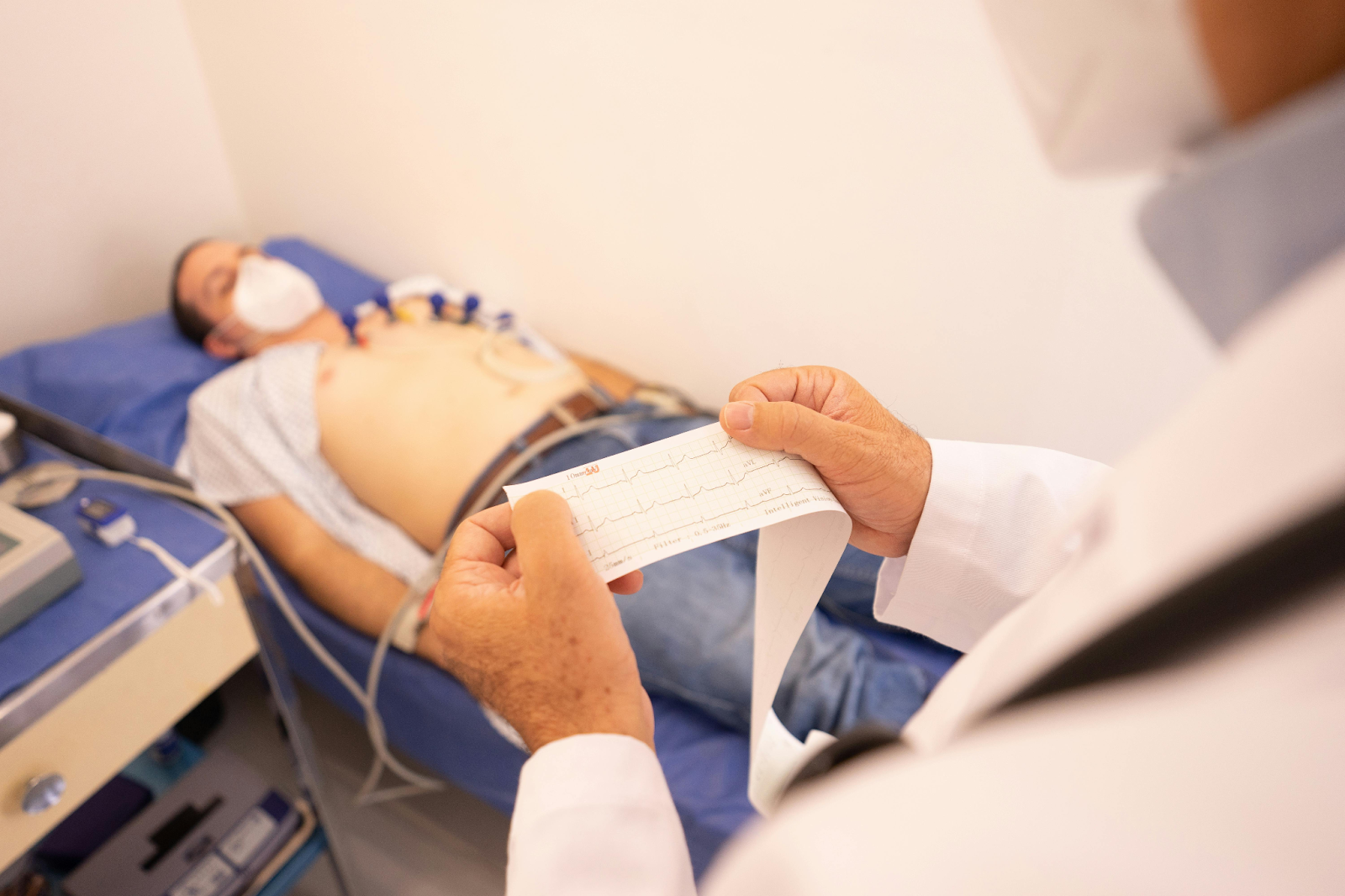
When you experience heart palpitations or chest discomfort, finding a reliable location for an EKG quickly is paramount. This guide explains how walk-in clinics offer accessible heart screenings, what the procedure entails, and how to interpret the results without the long wait times of an emergency room.
Often, it starts with a tightness in the chest. Or maybe just a flutter. That strange, persistent skipping beat that refuses to settle down. Your instinct kicks in, and you pull out your phone. Next thing you know, you are typing “EKG near me” because you need answers now, but the thought of sitting in a chaotic hospital waiting room for six hours sounds miserable.
We understand that anxiety.
At First Care Medical Clinic, we offer a different path – a calm, accessible alternative to the emergency department for symptoms that don’t require an immediate trauma team.
The truth is, you don’t always need the ER.
Choosing a walk-in clinic for a heart screening means you skip the triage lines entirely. You cut straight to the answers you need. Our team focuses on delivering professional diagnostic results with the urgency your health deserves, ensuring you aren’t left sitting in a plastic chair for half the day while wondering about your condition. Medical testing is stressful enough on its own (we understand that). The logistics shouldn’t have to add to the burden.
Understanding the EKG: Purpose and Terminology
To understand exactly what the terminology means, think of an electrocardiogram as a high-fidelity translator for your body. It captures those invisible electrical impulses that trigger your heartbeat and converts them into a visual graph our team can actually interpret. Every single time the heart muscle squeezes, a distinct wave of electricity ripples through. We catch the timing. Then we measure the intensity.
This specific data reveals whether your heart is beating with a steady, reliable rhythm or if it is struggling to keep pace.
EKG vs. EKG: What’s the Difference?
One day you see “EKG” scribbled on a referral slip. The next, your bill says “EKG.”
Confusing? It certainly can be.
But rest assured, they are the exact same test. The difference is strictly linguistic. The “K” leans on the original German spelling, Elektrokardiogramm. In the English-speaking medical world, most of us stick with EKG for a very practical reason. “EKG” sounds dangerously close to “EEG” (a brain wave test) when spoken quickly in a busy clinic environment.
Sticking with the “K” helps us avoid confusing your heart with your head. That said, the acronym itself matters far less than the answers the test actually provides.
Connecting Symptoms to Conditions
Your body rarely keeps secrets. It usually drops hints before a major event occurs. Sometimes these signals are loud – like a sharp pain that stops you in your tracks – but often they are subtle whispers. A weird flutter here. A spell of dizziness there.
At First Care Medical Clinic, we use EKGs to bridge the gap between what you are feeling and what is physically happening inside the chest cavity.
We often get asked if this test can specifically detect a heart blockage.
The reality is that while an EKG doesn’t take a physical picture of your arteries the way an angiogram would, it provides critical evidence. If a blockage is preventing oxygen from reaching the heart muscle, the electrical wave changes shape. Distinctly.
It might not show us the fire itself. But it definitely shows us the smoke.
The Value of Prevention
Waiting for chest pain isn’t the best strategy.
Silent issues are surprisingly common. Routine heart screenings are recommended especially for adults over 40 with risk factors. Taking a preventative approach allows us to catch electrical anomalies early. Before they become emergencies.
Now that the “what” and “why” make sense, the logistical questions usually pop up. You need to know where to go to get this done without navigating the labyrinth of a major hospital system.
Where Can I Go to Do an EKG?
Finding a place to get tested isn’t the hard part. The real challenge is picking the right facility based on how urgent your symptoms actually are.
You essentially have four main avenues to explore: the Emergency Room, your regular doctor, independent testing labs, or an urgent care center like ours at First Care Medical Clinic. They aren’t interchangeable. Before analyzing the differences, we need to address the most critical scenario. If you have severe chest pain, difficulty breathing, or signs of a heart attack, do not finish reading this page. Go to the ER immediately. Hospitals are specifically equipped for those life-or-death crises where survival depends on seconds.
That said, the ER isn’t always the best fit.
It is notorious for high costs and brutal wait times for anyone not actively dying. If your situation is stable – maybe you just need clearance before a minor surgery or want to investigate some mild fluttering – the hospital is probably overkill.
The Walk-In Advantage
This is where walk-in clinics fit into the picture.
We often get asked if patients can actually get an EKG at a standard walk-in facility. The answer is yes. Urgent care centers essentially fill the huge gap between your regular doctor and the chaos of the ER.
At First Care Medical Clinic, we define our approach by accessibility. You don’t need to navigate phone trees to find an appointment slot three weeks from Tuesday. You just walk in.
We can quickly identify arrhythmias, evidence of past heart events, and other electrical issues. The process is efficient. If our providers see something we can manage right here, we treat it; if the readout shows an active crisis that needs a full hospital team, we handle the transition to emergency services immediately.
What About Labs?
Diagnostic chains are probably on your radar, too. We hear the question: “Can I get an EKG at a lab?” While many specialized testing centers do perform electrocardiograms, the process is different. You typically need a requisition form from a separate doctor just to get through the door. You can’t just walk in. You arrive, a technician hooks up the electrodes to capture the data, and then you leave.
The results go to your doctor for review days later.
This system works fine for routine annual physicals where time isn’t a factor, but it lacks a feedback loop. When you come to an urgent care clinic for heart screening, a medical provider is actually in the building. We don’t just print the lines on the paper; we read them.
If we identify an abnormality, we discuss it with you immediately. You aren’t left waiting by the phone for a week just wondering what the test found. That specific kind of peace of mind is hard to price. Once you settle on where to go, the next hurdle is simply getting ready for the visit. It is a simple test. That said, a few small prep steps can help ensure the results are as clear as possible.
Once you settle on where to go, the next hurdle is just getting ready for the visit. It is a simple test, but a few small prep steps can make sure the results are as clear as possible.
What to Expect: Preparation and Procedure
Most people worry about the wardrobe aspect, but the rules are refreshingly simple.
We always recommend sticking to a two-piece outfit.
The logic here is purely practical. Wearing a separate top and bottom allows you to expose your chest for the electrodes without the awkward dance of trying to remove a dress or jumpsuit. It avoids the hassle. That said, sticking to separates also ensures the process remains private and comfortable for everyone involved. We usually find that a loose blouse or a standard button-down works best.
There is one specific detail regarding your morning routine that matters.
Please hold off on applying oily lotions, creams, or baby oil to your chest before you come in. This is strictly practical. The sticky electrodes we use need a clean, dry surface to get a solid grip, and any oil acts as a barrier. This slipperiness causes the sensors to slide around or ruin the signal quality. If moisturizing is a non-negotiable part of your morning ritual, we understand. Just skip the chest area for one day.
Having a clear record of what you take helps our team interpret the results correctly. Certain prescriptions can naturally speed up or slow down your rhythm, and we need to know exactly what is influencing the data to give you an accurate assessment.
During the Test
Once you are inside the exam room here at First Care Medical Clinic, the actual process is straightforward. You lie back on the table. Then, a technician cleans small areas of your skin to make sure we get a strong connection.
Next up is the hardware.
One thing we always clarify is that the test is non-invasive – there are no needles involved. None. You won’t feel any electrical shocks or pain. The machine acts more like a microphone; it simply records the electricity your heart generates on its own and translates it into those squiggly lines on the monitor. It just listens. Your only job is to lie still and breathe normally.
Most patients are actually surprised by how quickly the whole thing wraps up. You barely have a chance to settle in and get comfortable before our technician is already peeling the stickers off your chest. It is fast. The full EKG heart test usually clocks in at just 5–10 minutes. This speed makes a practical difference. You can easily fit a screening into a chaotic Tuesday afternoon or even a standard lunch break without throwing your whole schedule off track. We know how valuable your time is; getting the answers you need shouldn’t require taking an entire day off work.
That said, understanding the limitations is helpful.
The EKG is excellent for spotting rhythm issues and electrical abnormalities. But it is basically a snapshot. Since it tracks electrical conduction at one specific moment, it cannot show us the physical shape of the heart muscles (or how the blood is pumping through the valves). For that kind of structural detail, we have to look at a completely different diagnostic tool.
EKG vs. Echocardiogram: Knowing the Difference
We certainly understand why these get mixed up. The names sound clinical and they share that starting letter (plus they both deal with the heart). But relying on an EKG to find a leaky valve is a dead end. It is like trying to fix your plumbing by checking the fuse box. You won’t find the problem.
At First Care Medical Clinic, we want you to understand why we might order one test over the other. While these tools complement each other, they tell two completely different stories about your cardiac health.
Here is the functional breakdown:
- The EKG (Electrocardiogram) Focus: Electricity and Rhythm.
- Method: We place sticky electrodes on the skin to record both the timing and strength of electrical signals.
- Primary Use: This is our go-to method for detecting arrhythmias or identifying heart attacks (past and present). It is also excellent for spotting conduction blocks where the signal isn’t traveling the way it should.
- The Echocardiogram Focus: Structure and Movement.
- Method: Using an ultrasound probe – very similar to the technology used in prenatal imaging – we utilize sound waves to create moving pictures of the heart.
- Primary Use: It acts as a window. This allows us to visualize how thick the heart walls are, verify if valves are closing tightly, and measure the blood volume output with every beat.
In most cases, the EKG acts as the first step. It’s fast. Non-invasive.
It gives us immediate data on the heart’s rhythm. But if we spot an anomaly there, or perhaps a provider hears a murmur during a standard physical exam, the strategy changes. That is when the echocardiogram comes into play as a secondary investigation to look at the physical machinery of the organ.
Once we have captured the electrical data from your EKG, the interpretation phase starts. We have to decode what those jagged lines actually mean for your daily life.
Interpreting Results and Next Steps
Waiting for medical test results is stressful. We get that. At First Care Medical Clinic, we try to cut that tension out of the equation completely.
Because an EKG captures electrical activity as it happens, you aren’t stuck waiting days for an off-site lab to call you back. The data is right there. Our onsite provider looks at the tracing almost immediately, scanning for patterns that reveal how your heart is functioning in that exact moment.
First up? The heart rate itself.
Modern machines spit out automated numbers instantly, sure, but we often double-check them manually. It’s called the 6-second rule. Think of it as a quick backup verification using the actual graph paper. We just count the complete heartbeats – those tall spikes doctors call R waves – that land inside a six-second window.
Take that number and multiply by ten. Simple math.
This quick calculation gives us your rate in beats per minute, serving as an old-school safety check to ensure the digital reading is actually telling the truth.
Breaking Down the Findings
The goal? Leaving with a report that reads “Normal Sinus Rhythm.”
Don’t let the medical jargon throw you off. That is just clinical speak for a regular, healthy heartbeat. It means the electrical impulse is behaving exactly as it should – starting at the top of the heart and traveling downward in a perfect, predictable rhythm.
Then there are the times the chart simply reads “Abnormal.” We know seeing that word can make your stomach drop. But take a breath. That term is a massive umbrella covering everything from insignificant blips to acute conditions. When we see this result, it usually indicates:
- Speed issues: This covers the extremes. We look for Bradycardia (significantly too slow) or Tachycardia (racing way too fast).
- Arrhythmias: These are irregular patterns in the rhythm, such as Atrial Fibrillation (AFib).
- Ischemia: A sign that specific areas of the heart muscle aren’t receiving quite as much oxygen as they need.
What Happens After an Abnormal Result?
Other times, we might spot something that isn’t an immediate crisis. Maybe an arrhythmia you did not know you had. In that scenario, our job is to act as a bridge. We take the time to sit down, explain exactly what the graph shows, and connect you with a cardiologist. They are the ones who can look closer. Expect them to recommend follow-ups like stress tests or echocardiograms to understand the full picture.
But in those rare moments where an EKG flags an active heart attack or a life-threatening blockage? We act.
We coordinate immediate transfer to the nearest Emergency Room without delay.
Knowing where you stand with your heart health offers huge peace of mind, but we know the medical side is only half the battle; practical concerns usually follow. Before you book a screening, it makes sense to look at the financial aspect of these tests.
Cost of EKG Tests and Insurance Coverage
Unexpected bills are the worst.
Dealing with potential heart issues is stressful enough on its own; you certainly don’t need the added anxiety of a confusing invoice arriving weeks later. At First Care Medical Clinic, we believe financial transparency is just as vital as clinical excellence.
For patients paying out of pocket, we make every effort to keep our rates accessible. While the final cost can vary depending on whether your visit requires additional consultation or other testing, getting an EKG at an urgent care center is generally a fraction of the price you would encounter at a hospital. Consider ER facility fees. They can easily run into the thousands before a doctor even steps through the curtain to see you.
By choosing an urgent care setting for concerns that aren’t life-threatening, you are making a practical financial decision that preserves the quality of your care.
Then there is the topic of insurance.
We accept most major insurance plans (as well as Medicare and Medicaid). For the vast majority of people walking through our doors, an EKG is a covered benefit.
That said, there is one specific distinction you should understand involving medical necessity.
Most insurance carriers cover diagnostic tests, but they generally require that the exam is deemed necessary to treat or identify a specific condition. If you visit us describing symptoms – think shortness of breath, heart palpitations, or chest discomfort – an EKG is viewed as a critical tool to figure out what is wrong. Coverage is rarely an issue in those scenarios. But if you request a screening purely out of curiosity? That is different. Without active symptoms or known risk factors, some plans might classify the test as elective.
It never hurts to check your specific plan details if you feel unsure.
Prioritizing Your Heart Health at First Care
There is no upside to waiting when your chest feels tight or your heartbeat falls out of rhythm. None.
You do not need a referral slip. Our team exists to give you clarity fast.
Take that step today. If something feels off, come see us. Right away. You can head straight into your nearest clinic for a same-day EKG or reserve a spot online to bypass the waiting room. Your heart works hard for you every single second; let us help you keep it running smoothly.